Air Force Aviation Icon Set EPS: A Practical Guide to Choosing and Using Vector Icons for Military and Aviation Projects
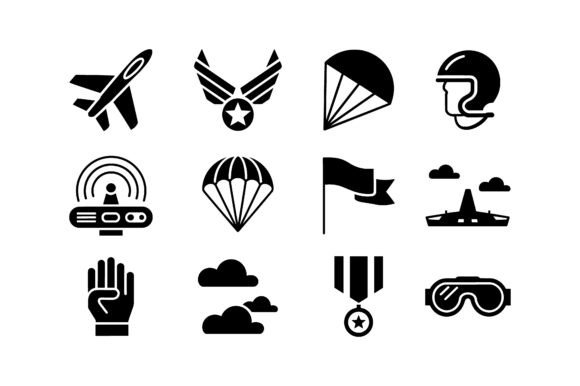
When you need strong, clear visuals for a military aviation project, the right icon set can make all the difference. Whether you are designing materials for a veterans’ memorial event, building a brand for an aviation club, or creating merchandise for an airshow, icons that communicate instantly and professionally are essential. The Air Force Aviation Icon Set EPS offers a collection of 12 glyph-style icons covering fighter jets, pilot helmets, medals, parachutes, and other military aviation symbols. But choosing—and using—a vector icon set involves more than just downloading a file. Many people make avoidable mistakes that cost them time, quality, and money. This article walks you through what to look for, what to watch out for, and how to get the best results from an icon set like this one.
What the Air Force Aviation Icon Set EPS Actually Delivers
This icon set is delivered as a single EPS file containing 12 silhouette-style vector icons. The design approach is bold and clean, with each icon reduced to its essential shape. That makes them highly readable at small sizes and impactful when scaled up. The EPS format means the icons are fully scalable to any resolution without losing quality—critical for projects that go from a business card to a banner. The set focuses specifically on military aviation themes: think fighter aircraft, headgear, parachutes, and service symbols. If your project needs that precise visual vocabulary, this set gives you a consistent, professional foundation.
What you won’t get is a package of multiple formats. The download includes only the EPS file. No SVG, PNG, or JPG versions are included. That is a deliberate choice, and understanding it upfront saves frustration later. For many designers and small business owners, EPS is the right starting point, but you need to know how to work with it.
1. Overlooking the format limitation until it is too late
The most common oversight is assuming that a vector file download will include multiple common formats. Many buyers see “vector” and expect SVG, AI, or PNG thumbnails alongside the EPS. When only an EPS file arrives, those without the right software—or without a clear workflow for converting EPS—hit a wall. You cannot drag an EPS into a web project directly, and not every design tool handles EPS gracefully.
How to avoid this: Before you purchase, confirm what software you will use to open and edit the EPS file. Adobe Illustrator, Affinity Designer, and CorelDRAW handle EPS natively. Free tools like Inkscape also work. If your workflow relies on PNG or SVG, plan to convert the EPS using your vector editor. Exporting to SVG or PNG from Illustrator takes seconds. Just know that step is on you.
2. Ignoring icon style consistency across a project
Silhouette-style icons have a striking, uniform look—when used correctly. A mistake people make is mixing this bold, glyph-style set with icons that have outlines, gradients, or detailed fills. The visual clash undermines the professionalism you are trying to achieve. The Air Force Aviation Icon Set EPS uses solid black silhouettes with no internal details. That works beautifully for patches, screen-printed T-shirts, or monochrome branding. But if your design uses multiple icon styles, this set may not blend well without adaptation.
Better approach: Use the entire set as your only icon source for a given project. If you need additional icons beyond these 12, either design complementary silhouettes yourself or choose a different set that matches the visual language. Consistency in stroke weight, fill style, and overall density keeps your design cohesive.
3. Assuming the icons will work at any size without adjustment
Vector files are resolution-independent, so scaling is mathematically perfect. That said, not every silhouette design reads well at very small sizes. A parachute icon with thin lines may lose clarity when scaled down to 16 pixels for a web button. The same icon at 200 pixels looks excellent. The mistake is not testing icons at the actual sizes they will be used.
Practical advice: After you download the EPS, open it and test each icon at the target sizes for your project. For small applications, simplify further or adjust stroke weights if needed. For large formats, check that the silhouette remains visually balanced. You have the vector files—take advantage of the editability.
Licensing and usage rights
Even though this is a simple icon set, always verify what you are allowed to do with the files. Some vector sets restrict commercial use, limit the number of copies you can produce, or require attribution. For a small business printing T-shirts or a freelancer building a logo, unclear licensing can cause problems later. Look for a license that explicitly allows commercial use, modification, and incorporation into larger designs. If the product page does not state terms clearly, reach out to the seller before purchasing.
Compatibility with your design software version
EPS files come in different generations. An older EPS generated by an outdated version of Illustrator may not open correctly in a newer application, or the reverse. If you use an older version of a design tool, ask about the EPS version included. Most modern files are EPS 10 or compatible, but it is worth checking if your workflow involves legacy software.
Icon naming and organization
Inside the EPS file, icons may be arranged on a single layer or spread across multiple layers. Some designers prefer organized layers with clear naming so they can isolate and export individual icons quickly. Others are fine selecting and copying. If you plan to use these icons frequently, you will save time if the file is well structured. Open the file in your vector editor and check. If the icons are not organized to your liking, take a few minutes to name and group them yourself. That small investment pays off every time you reuse the set.
Build a consistent brand around the icon style
Because the icons are bold silhouettes, they work well as the core of a visual identity for an aviation business or event. Pair them with a strong, blocky sans-serif typeface and a limited color palette. Use the fighter jet icon as a repeating pattern on event banners. Use the parachute icon as a supporting graphic on business cards. The simplicity of the style means you can extend it across many touchpoints without visual fatigue.
Combine with texture or color for depth
A silhouette icon does not have to stay black. In your vector editor, apply a camouflage pattern fill, a metallic gradient, or a distressed texture to give the icons a rugged military feel. Because the EPS file stores the icons as vector shapes, you can edit fill colors and apply effects freely. This is one of the strongest arguments for working with the EPS source file rather than a pre-rasterized PNG.
Use the icons as stencils or cut files
For physical projects like vinyl decals, stencils, or heat transfers for apparel, silhouette icons are ideal. The solid shapes cut cleanly on a vinyl cutter or plotter. You can import the EPS directly into cutting software like Silhouette Studio or Cricut Design Space. Just check that your software supports EPS import. If not, convert to SVG or DXF in your vector editor first.
Realistic Examples of Better Choices
Scenario 1: A flight school needs a logo and website icons. Instead of buying a generic icon set that mixes different styles, they choose this aviation-specific EPS set. The designer opens the EPS in Illustrator, selects the fighter jet silhouette, adjusts the proportions slightly, and adds a custom color gradient. The resulting logo is distinctive, relevant, and scalable. The other icons serve as supporting graphics on the website and in printed brochures. Consistency builds recognition.
Scenario 2: A nonprofit organizing a Memorial Day run uses these icons for T-shirt designs. The team avoids the mistake of rasterizing the EPS too early. Instead, they keep the design in vector form, apply a single color, and send the file directly to the screen printer. The printer thanks them—vector files produce cleaner screens and sharper prints. The event shirts look professional and the icons hold up after many washes.
Scenario 3: An educator preparing an infographic about military aircraft history downloads the set. Rather than importing the EPS directly into a presentation tool that does not support EPS, they first export each icon as a high-resolution PNG from Illustrator. The icons display clearly in slides and handouts. The instructor avoids the frustration of broken image links or blurry raster graphics.
What to Do After You Download the EPS File
Unzip the file you receive. Open the EPS in your vector editor of choice. Spend 10 minutes familiarizing yourself with each icon. Rename them if needed. Export a few key icons to PNG or SVG at the sizes you will use most often. Store the original EPS in a folder you can find later. By taking these steps immediately, you avoid scrambling for the right file format when a deadline is looming.
If you are new to working with EPS files, there are free resources online that walk through opening, editing, and exporting them. The learning curve is shallow, and the payoff is that you gain control over your design assets instead of being limited by fixed format files.
Final Thoughts on Choosing an Aviation Icon Set
The Air Force Aviation Icon Set EPS delivers exactly what it promises: a focused collection of 12 military aviation silhouettes in a single vector file. The value lies not in the number of formats included, but in the quality of the designs and the flexibility of the vector source. By understanding the format, testing icons at your target sizes, keeping your design style consistent, and taking a few minutes to organize the file, you avoid the common pitfalls that frustrate many buyers. Whether you are branding a flight school, creating merchandise for an airshow, or designing materials for a patriotic event, this icon set gives you a solid visual foundation. Use it wisely, and your designs will communicate strength, clarity, and purpose.