Understanding Target Audience Outline Icons: A Practical Guide for Smart Visual Decisions
When you are building a website, designing a mobile app, or preparing content for social media, the visual elements you choose carry as much weight as the words you write. Among the many graphic resources available, Target Audience Outline Icons have become a popular choice for creators who need clear, adaptable visuals that communicate ideas without overwhelming the viewer. But what exactly sets these icons apart, and how do they compare with other visual approaches? This article walks through the key considerations so you can decide whether outline icons fit your project or if another style might serve you better.
What Defines Target Audience Outline Icons
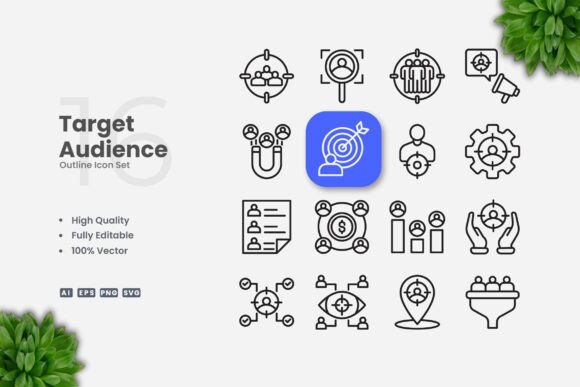
At its core, the concept behind Target Audience Outline Icons is straightforward: these are vector-based graphics that use clean lines and open shapes to represent people, groups, demographics, and engagement concepts. Instead of relying on filled colors or detailed shading, outline icons depend on stroke weight, contour, and negative space to convey meaning. This stripped-down approach makes them highly versatile across different media—from print materials like flyers and posters to digital platforms such as mobile apps and websites.
What makes this style distinct is the balance between simplicity and recognition. A well-designed outline icon can instantly communicate a target audience segment—whether you are illustrating a user persona, a market demographic, or a customer journey step—without demanding the viewer's full attention. The Target Audience Outline Icons set typically includes files like source AI, EPS version 10, SVG, and PNG transparency, which means you can open them in vector software such as Adobe Illustrator or CorelDRAW and adjust the color, stroke weight, or size to match your brand guidelines.
Because the icons are delivered as 100 vector files with editable strokes, you maintain control over the final look. This level of customization is a major advantage when you need consistency across a campaign or when you are adapting a single visual for multiple formats.
How Outline Icons Compare with Other Visual Approaches
When you evaluate Target Audience Outline Icons against alternative visual styles, several distinctions emerge. Each approach has its own strengths, and the best choice depends on your specific context.
Outline Icons vs. Filled or Solid Icons
The most direct comparison is between outline icons and filled icons. Filled icons use solid shapes to depict objects or people, often making them bolder and more visible at small sizes. For example, a filled person icon might appear as a dark silhouette with no interior detail. This can be effective for navigation bars or app buttons where quick recognition is essential.
However, filled icons can feel heavier and less flexible when you need to layer them on colored backgrounds or integrate them into a minimalist design. Target Audience Outline Icons offer a lighter visual footprint. Because they rely on strokes, they blend more easily with text-heavy layouts and do not compete for attention in the same way. If your project uses a lot of white space or a muted color palette, outline icons tend to feel more aligned with that aesthetic.
That said, filled icons may work better in contexts where contrast is limited—for instance, on very small screens or in low-resolution environments. If your primary concern is legibility at thumbnail size, a filled approach might be the safer route. On the other hand, if you value subtlety and the ability to customize colors without distorting the shape, outline icons give you more room to adapt.
Outline Icons vs. Custom Illustrations
Custom illustrations offer unlimited creative freedom. You can depict any scene, emotion, or detail with precision. For branding campaigns that rely on storytelling or emotional resonance, a bespoke illustration can be far more memorable than a generic icon set.
But custom illustrations come with tradeoffs. They are typically more expensive to produce, take longer to develop, and are harder to modify once created. If you need to represent a target audience in a consistent way across dozens of pages or platforms, commissioning original artwork for every variation may not be practical. Target Audience Outline Icons provide a middle ground: they are professionally designed yet affordable, and you can reuse and adapt them across different contexts. For many teams, this balance between cost, speed, and quality is exactly what they need.
Where illustrations excel is in creating a unique brand personality. If differentiation is your top priority and you have the budget, custom work may justify the investment. But if you need a reliable, scalable solution for communicating audience concepts—such as personas, segments, or engagement touchpoints—outline icons are often the more efficient choice.
Outline Icons vs. Photography
Photography brings realism and authenticity. A photo of a real person can convey emotion, context, and cultural cues that icons cannot. For case studies, testimonials, or human-interest stories, photography is hard to beat.
Yet photography also has limitations. Sourcing diverse, high-quality images that accurately represent your target audience can be time-consuming and expensive. Photos also carry specific cultural and contextual details that may not translate well across different regions or use cases. An outline icon, by contrast, is deliberately generic. It represents a concept—such as a "user" or "customer"—without locking you into a specific demographic detail. This abstraction can be a strength when your audience is diverse or when you need to avoid unintended biases.
For many projects, the best approach is to combine formats. You might use photography for hero sections or emotional storytelling, while relying on Target Audience Outline Icons for infographics, process flows, and supporting visuals. The icons can fill the gaps where photography would be too literal or too cluttered.
Strengths and Practical Tradeoffs
No single visual resource is right for every situation. Understanding the strengths and tradeoffs of Target Audience Outline Icons helps you decide when they add value and when you may need something different.
Strengths
Adaptability across media. Because outline icons are vector-based, you can scale them to any size without losing quality. Whether you are embedding an icon in a mobile app interface or printing it on a large banner, the result remains crisp. The included formats—AI, EPS, SVG, PNG—cover almost every common use case.
Customization without complexity. Changing the stroke weight, adjusting the color, or rotating an icon takes seconds in vector software. This makes it easy to maintain brand consistency across a campaign. If your brand color changes next quarter, you can update all icons in one batch.
Clean and modern aesthetic. Outline icons align with contemporary design trends that favor minimalism, clarity, and negative space. They work well in user interfaces where visual hierarchy is important and where you do not want icons to distract from content.
Efficient communication. A well-designed outline icon can convey a concept—such as "target audience" or "demographic group"—almost instantly. In infographics or data presentations, this speeds up comprehension and reduces cognitive load.
Tradeoffs and Limitations
Limited detail. By nature, outline icons simplify complex subjects. If you need to show nuanced differences between audience segments—such as age ranges, cultural backgrounds, or behavioral traits—an icon may not offer enough specificity. In those cases, a combination of icons and explanatory text or a custom illustration may be necessary.
Potential similarity to competitors. Because outline icon sets are widely used, there is a risk that your visuals may resemble those of other brands in your industry. If differentiation is critical, consider customizing the stroke style, color palette, or composition to make the icons feel more unique to your brand.
Small-screen considerations. On very small displays, thin strokes can become hard to see. If your primary platform is a mobile app with limited screen real estate, you may need to test the icons at various sizes to ensure they remain legible. Increasing the stroke weight or pairing icons with text labels can mitigate this issue.
When Target Audience Outline Icons Are the Right Choice
Based on the comparisons above, certain scenarios naturally favor the use of Target Audience Outline Icons.
- You need a consistent visual language across multiple formats. If you are producing content for a website, a mobile app, social media, and print materials simultaneously, outline icons give you a unified look that adapts easily to each medium.
- Your design aesthetic is minimalist or modern. Outline icons complement clean layouts, generous white space, and restrained color palettes. They feel intentional rather than decorative.
- You are working with limited time or budget. Compared to custom illustrations or extensive photo shoots, a well-organized icon set is a cost-effective and quick solution.
- You need to represent abstract concepts. For ideas like "audience," "engagement," "persona," or "segment," an outline icon provides a clear visual shorthand that most viewers will understand immediately.
- You value editability. If your team frequently updates branding or adapts materials for different campaigns, the ability to change colors, stroke weights, and sizes directly in vector software is a practical advantage.
When Another Approach May Serve You Better
While Target Audience Outline Icons are versatile, they are not always the optimal choice. Consider alternatives in these situations:
- You need high emotional impact. Photography or custom illustrations can evoke feelings that outline icons cannot. For fundraising campaigns, human interest stories, or brand launches that rely on emotional connection, invest in richer visuals.
- Your audience expects realism. In industries like healthcare, education, or social services, stakeholders may respond better to realistic imagery that reflects real people and environments.
- You are designing for very small interfaces. If your icons will appear primarily at 16×16 pixels or smaller, filled or solid icons typically offer better legibility.
- Brand differentiation is your top priority. If you need visuals that are instantly recognizable as uniquely yours, outline icons from a standard set may not provide enough distinction. Custom illustration or a proprietary icon style would be worth the investment.
Practical Examples of Use Cases
To ground these considerations in real scenarios, here are a few examples of when Target Audience Outline Icons can be applied effectively:
- Infographics. When visualizing survey data about customer demographics, outline icons can represent different age groups, locations, or interests without overwhelming the data. The clean lines keep the focus on the numbers and trends.
- Mobile app onboarding screens. Outline icons can illustrate key features or user benefits in a way that feels light and approachable. Because they are easy to resize, they work across different screen sizes.
- Marketing flyers and posters. For print materials where you need to communicate audience targeting quickly—such as event promotions or service overviews—outline icons add visual interest without competing with headlines.
- Social media carousels. In slide-based posts, outline icons can break up text and help guide the viewer through a narrative. Their simplicity makes them readable even on small phone screens.
Making an Informed Decision
Choosing the right visual resource is rarely about finding a single perfect option. More often, it is about understanding the tradeoffs and matching them to your priorities. Target Audience Outline Icons offer a strong combination of clarity, customizability, and efficiency. For many professionals—whether you are a marketer, a designer, a content creator, or a business owner—they represent a reliable foundation for communicating audience concepts across a wide range of media.
That said, the most effective visual strategies often mix different approaches. You might use outline icons for diagrams and process flows, photography for emotional storytelling, and filled icons for interactive elements. The key is to evaluate each project on its own terms: consider your audience, your medium, your budget, and the message you need to convey.
By weighing the strengths and limitations of Target Audience Outline Icons against other available options, you can make a choice that supports your goals without unnecessary complexity. And because the files are designed for easy drag-and-drop use with editable strokes and multiple format options, you have the flexibility to refine your visuals as your project evolves.
Whether you are launching a new website, designing a mobile app, or preparing materials for a presentation, the right icons can make your communication clearer and more professional. Taking the time to evaluate your options—rather than defaulting to the first available resource—is a step toward better design and more effective content.