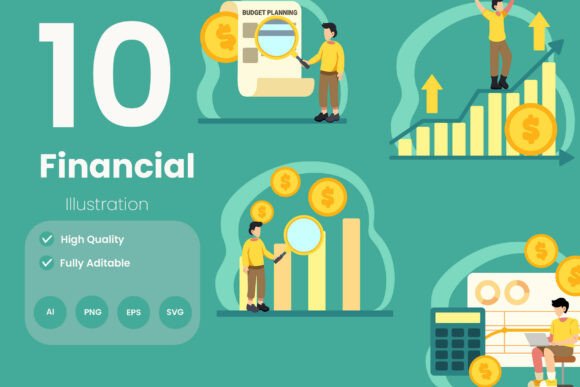
Building Financial Visuals That Communicate Clearly with a Strong Illustration Foundation
In any field where numbers, projections, and complex systems must be explained, visuals become the bridge between raw data and genuine understanding. Financial communication has long struggled with an inherent paradox: the concepts are critical, yet they are often abstract, unappealing, or difficult to grasp at a glance. From quarterly reports to mobile banking dashboards, the need for clean, professional, and adaptable visual assets has never been greater. Having a resource like a Financial Illustration Pack at hand changes how creators and professionals approach this challenge, not just by adding decoration, but by enabling a visual language that makes financial literacy more accessible and storytelling more effective.
The Challenge of Making Financial Concepts Visually Intuitive
Anyone who has tried to explain compound interest, risk diversification, or cash flow cycles knows that text and tables only carry the message so far. The human brain processes images much faster than text, yet financial imagery often falls into one of two traps: either it is overly literal (a stack of coins, a graph going up) or it is so generic that it fails to communicate anything specific. A well-rounded illustration collection avoids both pitfalls by offering a vocabulary of symbols, characters, and scenarios that can be mixed and matched to build a narrative. The Financial Illustration Pack addresses this by providing a cohesive set of graphics that cover money management, investment scenarios, banking interactions, growth indicators, savings behaviors, and planning workflows. Each illustration is designed not just to look professional, but to serve as a visual shortcut for an idea that would otherwise require several paragraphs to explain.
For example, an illustration showing a character reviewing a chart with a shield in the background instantly communicates the concept of secure investment tracking. A visual of funds flowing between piggy banks, arrows, and a growing plant conveys savings and growth without a single word. This kind of intuitive communication is valuable whether the audience is a board member reviewing a pitch deck or a student learning about budgeting for the first time.
How Vector Graphics Change the Workflow for Financial Content
The technical format of an illustration pack is just as important as its visual style. Raster images have long been a standard, but they come with limitations when scaling or customizing for different mediums. Vector graphics, which form the core of a quality Financial Illustration Pack, solve these limitations elegantly. Because vectors are based on mathematical paths rather than pixels, they can be resized from a tiny icon on a mobile app to a full-page print in a report without losing sharpness or detail. This scalability is essential for financial materials that often need to appear across multiple formats: a social media graphic, a slide in a presentation, a section in an annual report, and a large banner at a conference booth.
Beyond scaling, vectors offer deep customization. Color schemes can be adjusted to match brand guidelines, elements can be repositioned, and components from different illustrations can be combined to create entirely new scenes. The inclusion of multiple file formats such as AI, EPS, SVG, JPG, and PNG ensures that users working in Adobe Illustrator, Affinity Designer, Sketch, or even browser-based tools like Canva or Figma can integrate the assets without conversion headaches. For a marketing team at a fintech startup, this means being able to take a single illustration of a mobile banking interface and quickly adapt it for a landing page, an email campaign, and an explainer video, all while maintaining a consistent visual identity.
Practical Applications Across Professional Contexts
The versatility of a dedicated illustration pack becomes most apparent when examining how different professionals put it to use. Each user group brings its own requirements, and the pack must be flexible enough to serve them all without feeling mismatched.
Educators and Trainers
Financial literacy programs, whether in high schools, universities, or corporate training sessions, rely heavily on visual aids. Abstract concepts like inflation, interest rates, and market cycles can be difficult for learners to internalize. With a Financial Illustration Pack, an educator can build slides that show a timeline of saving versus spending, a visual comparison of different investment vehicles, or a step-by-step illustration of how a loan amortizes. The clean, professional style keeps the focus on the content rather than on whimsical or distracting imagery, which is especially important in academic or certification-oriented settings. In these contexts, the illustrations serve as scaffolds for learning, helping students form mental models that stick.
Startups and Small Business Owners
For an early-stage company, especially in the fintech or financial services space, presenting a polished image is critical for building trust. A startup may not have the budget for a full-time designer or a custom illustration system, but it still needs pitch decks, website visuals, and product screenshots that look credible. Using a Financial Illustration Pack allows a solo founder or a small team to create materials that rival those of larger competitors. The illustrations can be used to visualize the user journey, explain the value proposition, or break down how a new payment feature works. Because the pack includes both abstract concepts (like growth charts and planning calendars) and human-centered visuals (like people using apps or discussing finances), the startup can tell a complete story without needing to commission dozens of custom pieces.
Agencies and Freelance Designers
For creative professionals who work with multiple clients, having a reliable library of financial assets is a major efficiency gain. Rather than starting from scratch for every banking client or investment platform project, a designer can pull from the pack to create mood boards, wireframes, and final comps quickly. The ability to customize colors and resize elements means that the same base illustration can be used for a luxury wealth management brand and a budget-friendly personal finance app, with adjustments to color palette, typography integration, and layout. This flexibility not only saves time but also ensures that the designer can maintain a high standard of visual consistency across projects. The Financial Illustration Pack becomes a tool for scaling creative output without sacrificing quality.
Content Creators and Marketers
Digital content about personal finance, investing, and economic trends has exploded in popularity. Blog posts, YouTube thumbnails, social media carousels, and newsletter headers all benefit from strong visuals that grab attention and convey the topic immediately. A marketer or content creator can use the illustrations to create a recognizable visual brand for a finance blog or Instagram account. For example, a series of posts about budgeting tips could consistently feature illustrations from the pack with a unified color scheme, making the content instantly recognizable as part of that series. The pack also supports infographic-style layouts, where multiple illustrations are combined to show a process or comparison, which is highly effective for platforms like Pinterest or LinkedIn.
Customization Workflows for Different Skill Levels
One of the overlooked strengths of a well-structured illustration pack is how it accommodates users with varying levels of technical expertise. A professional designer will likely open the AI or EPS files in Adobe Illustrator, where they can access every anchor point and layer individually. They can change the gender or posture of a character, swap out a chart type, or merge elements from multiple illustrations to create a custom scene. For someone less experienced with vector editing, the SVG format offers a middle ground. SVG files can be opened in free tools like Inkscape or even edited with basic code in a text editor, making simple color changes accessible without expensive software.
Users who only need static images for presentations or print can rely on the high-resolution JPG and PNG files, which are ready to use immediately. The presence of transparent backgrounds in the PNG files is particularly useful for layering illustrations over branded backgrounds or photographs. This tiered approach means that a financial advisor preparing a client presentation, a teacher making a worksheet, and a designer building a full website can all use the same pack in ways that suit their workflow, without any of them feeling that the assets are too complex or too limited for their needs.
Considerations When Selecting Financial Visuals
Not all illustration packs are created equal, and the effectiveness of visual assets depends on several factors beyond just the drawing style. The breadth of concepts covered matters. A pack that only offers a few generic icons of money and graphs will quickly feel repetitive. A comprehensive pack, by contrast, provides enough variety to tell a complete story across multiple pages or screens. The Financial Illustration Pack covers a wide range of scenarios from banking and investment to savings and planning, which reduces the need to mix assets from multiple sources that might have conflicting art styles.
Another important factor is the tone of the illustrations. Financial content often deals with sensitive topics like debt, retirement planning, or economic uncertainty. Visuals need to be approachable without being childish, professional without being cold, and engaging without being frivolous. The modern, clean style of this pack strikes a balance that works for both corporate annual reports and consumer-facing apps. The characters are diverse and relatable, which helps audiences see themselves in the scenarios being depicted. This inclusiveness is not just a nice-to-have; it directly affects how well the message is received across different demographics.
File format support is another practical consideration. Teams that collaborate across different operating systems and software platforms need assurance that the files will open correctly. The inclusion of AI, EPS, SVG, JPG, and PNG covers nearly every common use case. For web developers, SVG files are especially valuable because they can be styled with CSS and scaled responsively without loading multiple image sizes. For print designers, the AI files provide full editability for color separation and spot color adjustments. This level of format coverage ensures that no one in the workflow gets stuck converting files or dealing with compatibility issues.
Integrating Visuals into a Broader Communication Strategy
Illustrations work best when they are part of a deliberate visual strategy rather than an afterthought. A financial website that uses illustrations consistently across its help center, blog, and product pages builds a stronger brand identity than one that uses stock photos with inconsistent lighting and composition. The Financial Illustration Pack supports this kind of intentional design because its assets are visually cohesive. They share a common line weight, color philosophy, and level of detail, so mixing and matching does not create visual noise.
For a business that is building a new app or platform, using illustrations from the start can guide the user experience. Error states, empty states, onboarding screens, and success messages all become opportunities to reinforce the brand and educate the user. A well-placed illustration of a growing plant can turn a simple "your savings goal is on track" message into a moment of delight and motivation. In contexts like these, the illustration is not just decoration; it is a functional part of the interface that communicates status, progress, or encouragement.
Even in print materials, such as brochures, direct mail, or event signage, the same illustrations can be adapted. The vector files allow for scaling up to large formats, and the design style ensures that the visuals remain crisp and professional even at poster size. This consistency across digital and physical touchpoints creates a unified brand experience that builds trust and recognition over time.
Future-Proofing Content with Scalable Assets
Trends in design change, but the need for clear financial communication remains constant. Investing in a vector-based illustration pack is a long-term decision because the files can be updated as branding evolves. If a company rebrands with new colors, the hues in the illustrations can be adjusted in minutes. If a new financial product is launched, existing illustrations can be recombined to tell that story without needing a new photoshoot or custom artwork from scratch. This adaptability makes the Financial Illustration Pack a practical investment for any team that produces financial content regularly, from marketing departments to educational publishers.
Furthermore, as more content moves to interactive and responsive formats, having SVG files available means that illustrations can be animated, hovered over, or scaled dynamically based on screen size. This opens the door for more engaging digital experiences, such as interactive infographics or animated explainers, without starting from zero. The initial effort of selecting and customizing the illustrations pays dividends across multiple projects and campaigns.
Ultimately, the value of a financial illustration pack is measured not just by the quality of the individual drawings, but by how well it integrates into the real workflows of the people who use it. When a resource saves time, reduces friction, and elevates the quality of the final output, it becomes an essential tool rather than just another asset folder. For anyone involved in creating financial communications, having access to a versatile, scalable, and professionally designed collection makes the difference between content that is merely informative and content that is truly understood.