Personal Saving Outline Icons: A Strategic Tool for Clear Visual Communication
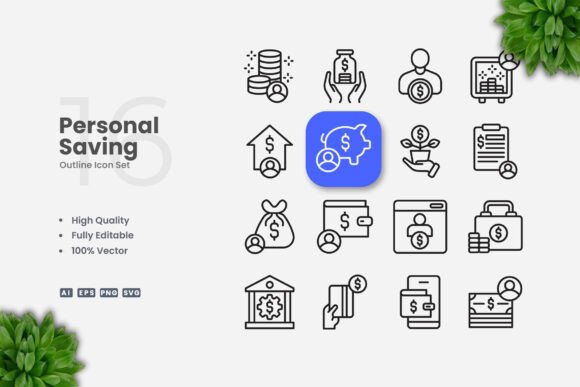
In a landscape where attention is scarce and clarity is currency, the visual language you choose can significantly influence how your message is received. Whether you are developing a budgeting app, designing a financial literacy brochure, or creating content for social media, the icons you select carry weight. Personal Saving Outline Icons offer a particularly effective solution for those who need to represent financial concepts, saving goals, and money management strategies in a way that is both intuitive and professional. These icons, built on a simple and clean design philosophy, are not just decorative elements—they are strategic tools that can enhance understanding, improve user experience, and support your broader communication goals.
When you work with a set of 100 vector icons that are fully customizable, you gain more than just visual assets. You gain the ability to adapt your visual identity across multiple platforms without losing consistency. The editable stroke feature means you can adjust line weights to match your brand’s aesthetic, while the ability to change color allows you to align icons with your existing color palette or with the emotional tone of your content. This flexibility is particularly valuable for entrepreneurs, marketers, and creators who need to maintain a cohesive look across websites, mobile apps, print materials, and social media.
Why Thoughtful Icon Selection Matters for Your Goals
Every design decision you make either supports or undermines your objectives. Icons are no exception. When you choose outline icons for personal saving topics, you are making a deliberate choice to prioritize clarity and simplicity over decorative complexity. This decision matters because financial concepts can be abstract and intimidating. A well-designed piggy bank icon, a coin stack, or a growth chart can instantly communicate a saving concept without requiring the user to read a single word.
From a planning perspective, using a consistent set of outline icons helps you build a visual system that users can learn and trust. If you are designing a mobile app that helps users track their savings goals, using the same icon for “goal” across different screens reduces cognitive load. Your audience does not need to relearn the interface each time they encounter a new feature. This consistency supports better user retention and can improve the overall effectiveness of your product.
For professionals working on financial literacy materials, such as educators or publishers, these icons serve as bridges between complex information and audience understanding. A simple outline icon representing “emergency fund” or “compound interest” can make a brochure or infographic more approachable. When your audience can grasp the core idea at a glance, they are more likely to engage with the content and stay with you long enough to absorb the deeper message.
Strategic Use Cases Across Platforms and Projects
The versatility of personal saving outline icons means they can be applied across a wide range of projects with minimal adjustment. Consider the following scenarios where these icons can add real value:
- Website and Mobile App Design: Icons are essential for navigation, feature highlighting, and call-to-action buttons. Using outline icons with an editable stroke allows you to match the line weight to your interface design, ensuring a seamless visual flow. For a personal finance app, icons for “budget,” “savings,” “investments,” and “expenses” become the primary way users interact with your tool.
- Books and E-books: Financial guides, personal development books, and educational materials benefit from chapter icons or section markers. A set of consistent outline icons can break up text-heavy pages and give readers visual cues about the content they are about to read.
- Social Media Content: In a crowded feed, simple outline icons stand out without overwhelming the viewer. You can use them in infographics, quote cards, or tip posts to make your content more scannable and shareable. Because the icons are vector-based, you can resize them for Instagram stories, LinkedIn posts, or Pinterest pins without losing quality.
- Print Materials: Flyers, brochures, posters, and banners often require icons that print cleanly at various sizes. Outline icons are particularly well-suited for print because they remain legible even at small sizes and do not rely on complex gradients or textures that might reproduce poorly.
Each of these use cases benefits from the core features of the icon set: high quality, 100 vectors, and easy customization. But the strategic advantage lies in how you use them. Before you drop an icon into a design, ask yourself what role it needs to play. Is it guiding the user’s eye? Is it explaining a concept? Is it reinforcing a brand value? When you answer those questions first, your icon choices become intentional rather than decorative.
How to Approach Customization Without Losing Consistency
One of the most powerful aspects of working with vector icons is the control you have over their appearance. However, customization should be approached with a clear plan. Random changes in stroke weight, color, or style can undermine the visual cohesion of your project. Here are some practical guidelines to keep your icon set working as a unified system:
- Define a stroke weight standard before you begin. If you are designing for a mobile app, a stroke weight of 2px may look balanced. For a poster or banner, a heavier stroke might be necessary for visibility. Decide on a range and stick to it across all icons you use.
- Choose a color palette that aligns with your message. For personal saving content, colors like green (growth), blue (trust), and neutral tones (clarity) are common choices. Avoid using too many colors in a single composition, as it can distract from the icon’s function.
- Resize icons proportionally. Distorting an icon by stretching it unevenly can make it look unprofessional. Vector editing software like Adobe Illustrator and CorelDRAW allows you to maintain proportions easily.
- Test icons at different sizes. An icon that looks clear on your computer screen may become muddy when printed at a small size or displayed on a mobile device. Always test your icons at the actual sizes they will be used.
When you follow these steps, you ensure that your icons remain a tool for clarity rather than a source of visual noise. The goal is to have your audience focus on the content, not the icon itself. A well-crafted outline icon should feel almost invisible—so natural that it seamlessly guides the viewer’s understanding.
Risks of Using Icons Without Clear Context
Even the best-designed icons can work against you if they are used carelessly. One common mistake is selecting an icon that looks visually appealing but fails to communicate the intended concept. For example, using a dollar sign icon to represent “long-term savings” may be too generic and miss the nuance of a specific financial goal. Another risk is overloading a design with too many icons, which can create visual clutter and reduce the impact of each individual symbol.
Additionally, icons that are not customized to fit the overall design can feel disconnected from the brand. If your brand uses thin, minimalist lines but your icons are heavy and bold, the inconsistency will be noticeable to users—even if they cannot articulate what feels off. This is why the editable stroke and color customization features are so important. They give you the tools to integrate the icons fully into your visual language.
From a decision-making standpoint, it is also worth considering your audience’s familiarity with icon conventions. While a piggy bank is widely recognized as a symbol for saving in Western cultures, it may not carry the same meaning globally. If your project reaches an international audience, research whether your chosen icons translate well across cultural contexts. A simple outline of a safe or a lock may be more universally understood for security-related saving concepts.
Planning for Long-Term Use and Scalability
When you invest in a set of 100 personal saving outline icons, you are building a resource that can serve you across multiple projects over time. To maximize this investment, think ahead about how you will organize and store your files. The included formats—AI, EPS 10, SVG, and PNG with transparency—give you flexibility, but only if you maintain a system for retrieving them.
Consider creating a master folder where you keep the original vector files alongside the exported PNGs and SVGs. Name each icon consistently so you can find it quickly when you need it. For example, instead of naming a file “icon1,” use descriptive names like “piggy-bank-outline” or “coin-stack-simple.” This small organizational habit saves time and frustration when you are working under a deadline.
As your business or project grows, you may need to expand the icon set or modify existing icons to fit new contexts. Because the icons are vector-based and fully editable, you can easily create variations—such as a filled version of an outline icon for hover states on a website, or a larger version for a banner headline. This scalability is one of the strongest arguments for choosing vector icons over static image formats.
Practical Decision-Making Guidance for Creators and Professionals
If you are evaluating whether this icon set is right for your next project, consider your specific needs rather than following trends. Ask yourself these questions:
- Does my project involve financial or saving-related content that would benefit from consistent visual cues?
- Do I need icons that work across multiple media types, from digital to print?
- Is it important for me to have control over stroke weight, color, and size?
- Will I reuse these icons in future projects, or is this a one-time use?
If the answer to most of these is yes, then a set like Personal Saving Outline Icons is likely a strategic fit. The value lies not just in the icons themselves, but in the flexibility they provide for ongoing use. For a freelancer designing a series of financial infographics, or a small business owner creating a budgeting workbook for clients, having a reliable, customizable icon library can be a significant time saver.
At the same time, avoid the temptation to use icons simply because they are available. Every element in your design should serve a purpose. If an icon does not clarify a concept, guide the user, or reinforce your message, consider whether it is needed at all. Thoughtful restraint often leads to stronger designs than excessive decoration.
Final Considerations for Achieving Better Results
Using personal saving outline icons effectively is about more than technical skills in vector editing software. It is about understanding how visual communication supports your goals, whether you are educating an audience, building a brand, or simplifying a user interface. The clean, simple design of these icons makes them a strong foundation, but your strategic choices determine how well they perform.
When you keep your audience’s needs at the center of your decisions, your icons become tools for empathy. They help people navigate financial information with less anxiety and more confidence. They make your content more accessible. And they allow you to maintain a professional, consistent visual identity across all the channels you use.
As you move forward with your projects, remember that the best icon sets are the ones that fade into the background of great design. They are noticed only in their absence. A thoughtfully applied outline icon for personal saving does not shout for attention—it quietly directs the viewer’s understanding. That subtle effectiveness is what separates good design from truly strategic communication.
With the right approach, the icons you choose today become part of a larger system that supports your work for months and years to come. Start by defining your goals, plan your customization, and apply each icon with intention. The results will speak for themselves.